
by lamidontist
You’re enjoying your favourite meal when you suddenly feel a dull ache at the very back of your mouth.
At first, you ignore it.
By evening, chewing becomes uncomfortable. The next morning, it hurts even to swallow, and you can barely open your mouth.
You look in the mirror but can’t see much.
“Is my wisdom tooth coming in?”
If you’ve asked yourself this question, you’re not alone. Wisdom tooth pain is one of the most common reasons young adults visit the dentist.
The good news? Not every wisdom tooth causes problems, and not every painful wisdom tooth needs to be removed. Understanding why it hurts is the first step towards finding the right treatment.
What is a wisdom tooth?
Wisdom teeth are the last set of molars (back teeth) to erupt into the mouth.
They usually appear between the ages of 17 and 25, a stage of life traditionally associated with gaining “wisdom”—hence the name wisdom teeth.
Most people have four wisdom teeth, one in each corner of the mouth. However, some people have fewer, and a few never develop wisdom teeth at all.
Why do wisdom teeth hurt?
Imagine trying to fit one more chair around a dining table that’s already full.
No matter how hard you try, there just isn’t enough room.
Something similar can happen inside your mouth.
By the time wisdom teeth try to erupt, all the other permanent teeth are already in place. If there isn’t enough space, the wisdom tooth may struggle to come through the gums, leading to pain, swelling and other problems.
Let’s look at the most common reasons.
1. The wisdom tooth is only partly visible
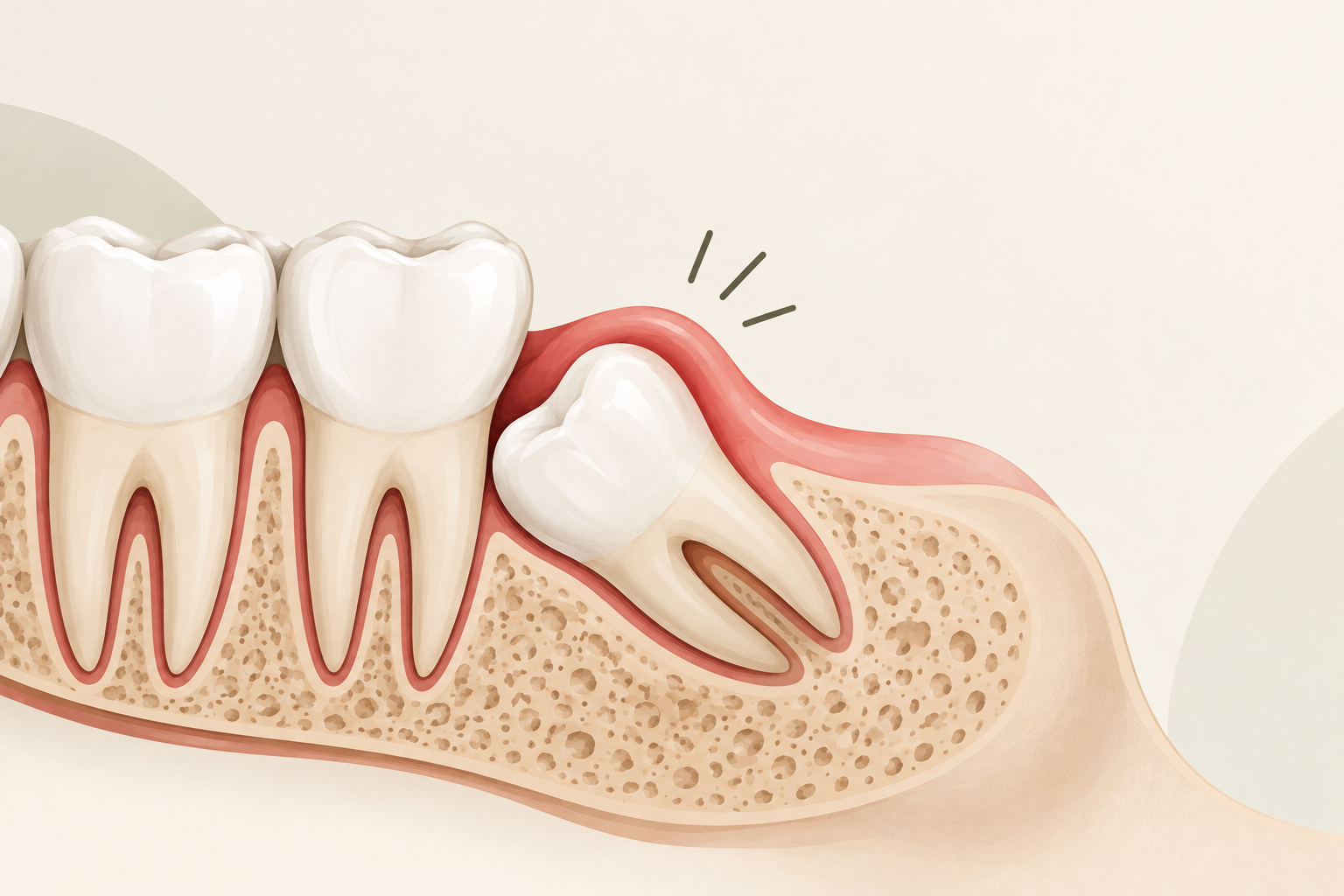
One of the most common causes of wisdom tooth pain is partial eruption.
This means that only part of the tooth has come through the gums, while the rest remains covered by a small flap of gum tissue.
Food particles and bacteria can easily get trapped under this flap because it’s difficult to clean.
Over time, the area becomes inflamed or infected—a condition called pericoronitis.
Symptoms may include:
- Pain at the back of the mouth
- Swollen gums
- Difficulty chewing
- Bad breath
- An unpleasant taste in the mouth
2. There isn’t enough space
Many jaws simply don’t have enough room for wisdom teeth.
As the tooth tries to erupt, it pushes against the surrounding gum or neighbouring tooth, causing pressure and discomfort.
Some people feel this as a dull ache, while others experience severe pain.
3. The wisdom tooth is impacted
Sometimes a wisdom tooth cannot erupt properly because it is blocked by bone, gum tissue or another tooth.
This is called an impacted wisdom tooth.
An impacted tooth may:
- Stay completely hidden beneath the gums
- Erupt only partially
- Grow sideways
- Push against the tooth in front of it
Not every impacted wisdom tooth causes pain, but some can lead to repeated infections, swelling or damage to nearby teeth.
4. Food keeps getting trapped
Have you ever had a popcorn kernel stuck between your teeth?
It’s uncomfortable until you remove it.
Now imagine food getting trapped every day under the gum covering a partially erupted wisdom tooth.
Because the toothbrush often can’t reach this area properly, bacteria multiply easily, leading to inflammation and pain.
5. The upper wisdom tooth keeps biting the swollen gum
This is something many patients experience, but few people know about.
Imagine accidentally biting the inside of your cheek.
Now imagine biting that same sore spot every time you eat.
It never gets a chance to heal.
The same thing can happen with wisdom teeth.
If the gum around a lower wisdom tooth becomes swollen, the upper wisdom tooth on the same side may keep biting against that swollen gum whenever you close your mouth.
For example, if your lower left wisdom tooth is inflamed, the upper left wisdom tooth may repeatedly press on the swollen gum.
This repeated irritation can make:
- Chewing painful
- Swallowing uncomfortable
- Opening your mouth difficult
- Healing slower
Sometimes patients think the lower wisdom tooth is the only problem, but the upper wisdom tooth may also be contributing.
In selected cases, if the upper wisdom tooth serves little purpose and repeatedly injures the swollen gum, your dentist may recommend removing the upper wisdom tooth to help the area heal.
6. Tooth decay
Wisdom teeth are located right at the back of the mouth, making them harder to brush.
As a result, plaque can build up more easily, increasing the risk of cavities.
A decayed wisdom tooth may become sensitive to sweets, cold drinks or chewing.
7. Gum infection
When bacteria build up around a wisdom tooth, the surrounding gums can become infected.
You may notice:
- Swelling
- Redness
- Pain
- Pus
- Bad breath
- Fever in more severe cases
These infections should not be ignored.
Why does it hurt to swallow or open my mouth?
Many people are surprised when wisdom tooth pain affects swallowing or opening the mouth.
This happens because the tissues around the wisdom tooth become inflamed.
When you swallow, chew or move your jaw, these inflamed tissues move too, making the area sore.
If the upper wisdom tooth is repeatedly biting onto the swollen gum, every movement of your jaw can make the pain feel worse.
Does wisdom tooth pain always mean it needs to be removed?
No.
This is one of the biggest myths about wisdom teeth.
Many wisdom teeth erupt normally, remain healthy and never need to be removed.
Your dentist may recommend keeping the tooth if it:
- Has enough space
- Is healthy
- Can be cleaned properly
- Is not causing pain or damage
Removal is usually considered only when the tooth is causing repeated problems or is likely to cause future complications.
Can the pain go away on its own?
Sometimes.
If the discomfort is caused by the tooth erupting through the gums, it may settle after a few days.
However, if the pain is due to infection, decay or an impacted tooth, it often returns until the underlying problem is treated.
Think of it like a leaking tap.
The dripping may stop for a while, but the leak hasn’t been repaired.
What can I do until I see a dentist?
While waiting for your appointment:
- Brush the area gently if you can.
- Rinse with warm salt water several times a day.
- Avoid chewing on the painful side.
- Drink plenty of water.
- Follow your dentist’s advice regarding pain relief if needed.
These steps may help reduce discomfort, but they won’t treat the underlying cause.
When should I see a dentist urgently?
Seek dental care promptly if you have:
- Severe pain
- Swelling of the face or jaw
- Difficulty swallowing
- Difficulty opening your mouth
- Fever
- Pus around the tooth
- Persistent bad taste in your mouth
These symptoms may indicate an infection that needs treatment.
How is wisdom tooth pain treated?
Treatment depends on what’s causing the pain.
Your dentist may recommend:
- Cleaning around the tooth
- Treating the gum infection
- Filling a cavity
- Prescribing medication when necessary
- Removing the wisdom tooth if it is causing repeated problems
- In some cases, removing the opposing upper wisdom tooth if it continues to injure the swollen gum
Every treatment plan is based on your individual condition.
Myth vs Fact
❌ Myth: Every wisdom tooth should be removed.
✅ Fact: Many wisdom teeth remain healthy for life. They are removed only when they are causing problems or are likely to cause future complications.
Lamidontist’s Quick Tip🦷
Pain at the back of your mouth is your body’s way of asking for attention.
Don’t wait until the pain becomes unbearable. A simple dental examination can identify the cause early and often prevent a small problem from becoming a bigger one.
Key Takeaways
- Wisdom teeth are the last teeth to erupt, usually between 17 and 25 years of age.
- Pain is often caused by lack of space, partial eruption, infection or impaction.
- Food trapped under the gum flap can lead to inflammation.
- Sometimes the upper wisdom tooth repeatedly bites onto the swollen gum around a lower wisdom tooth, making chewing and swallowing more painful.
- Not every wisdom tooth needs to be removed.
- Early dental care can prevent complications and relieve discomfort.
🌿 The Lamidontist Perspective
Wisdom teeth have a reputation for causing trouble, but they’re not always the villains they’re made out to be.
Many people keep their wisdom teeth for life without any problems. Others may need treatment because the tooth simply doesn’t have enough room to erupt comfortably.
If your wisdom tooth has started hurting, don’t panic—but don’t ignore it either.
The earlier the cause is identified, the easier it usually is to treat. Sometimes the solution is as simple as cleaning the area; other times, removing the troublesome tooth can bring lasting relief.
Your smile has served you every day. When it starts sending you warning signs, it’s worth listening.
Disclaimer: This article is for educational purposes only and should not replace professional dental advice. If you have severe swelling, difficulty breathing, difficulty swallowing or fever along with wisdom tooth pain, seek immediate dental or medical care.