
by lamidontist
You brush your teeth twice a day. You rinse after meals. You try to take good care of your teeth.
But have you ever looked at your toothbrush and thought:
“Isn’t this enough?”
Not quite.
Your toothbrush does a great job cleaning the surfaces of your teeth, but there are areas it cannot reach properly—especially the tight spaces between your teeth.
That is where flossing comes in.
Flossing helps remove food particles and plaque from between the teeth and along the gumline, where a toothbrush alone may not be able to clean effectively.
So, is flossing really necessary? And how are you supposed to do it without making your gums bleed?
Let’s make it simple.
What Is Flossing?
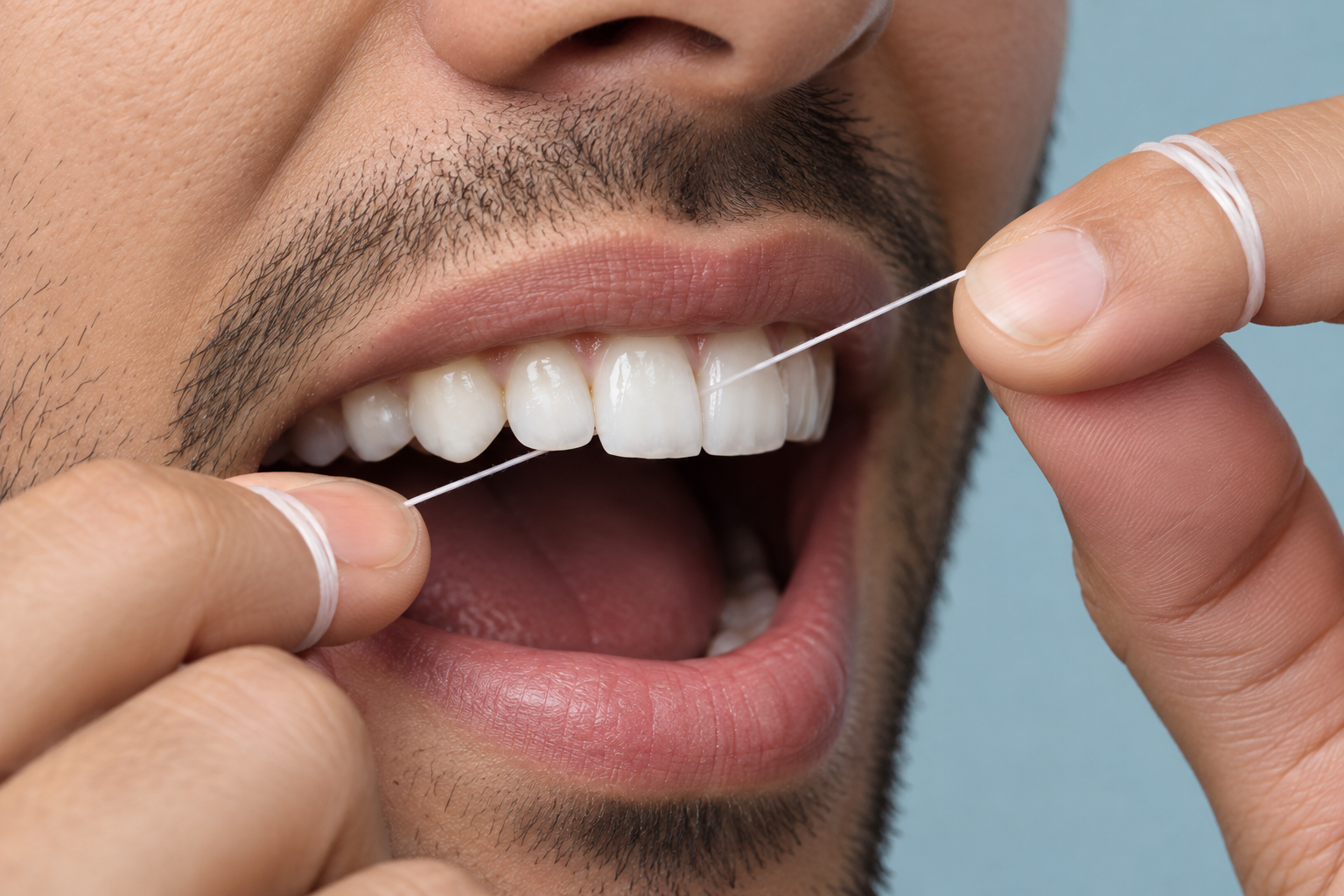
Flossing means using a thin piece of dental floss to clean between your teeth.
These spaces can trap:
- Food particles
- Plaque
- Bacteria
You might not always notice anything stuck between your teeth. But even when the space looks clean, a thin layer of plaque can still be present.
If plaque remains around the gumline for long enough, it can irritate the gums and contribute to gingivitis, causing redness, swelling, and bleeding.
Why Doesn’t Brushing Clean Everything?
Imagine sweeping the floor of your house.
You can clean the main area easily, but what about the narrow space between two pieces of furniture?
Your broom may not reach it properly.
Your teeth are similar.
A toothbrush cleans the front, back, and chewing surfaces of your teeth, but the bristles may not effectively clean the contact areas between closely positioned teeth.
Floss is designed to reach these narrow spaces.
That’s why brushing and cleaning between the teeth work together rather than replacing each other.
What Happens If You Don’t Clean Between Your Teeth?
Plaque can build up between the teeth and around the gums.
At first, you may not notice much.
Over time, however, plaque can irritate the gums and cause gingivitis.
You might notice:
- Red or swollen gums
- Gums that bleed while brushing or flossing
- Bad breath
- Tenderness around the gums
If plaque is left undisturbed, it can eventually harden into calculus (tartar). Unlike soft plaque, calculus cannot be removed properly with brushing and flossing alone and usually requires professional cleaning.
So flossing isn’t simply about removing that piece of spinach stuck between your teeth before an important meeting!
It’s about regularly disturbing and removing plaque from areas that are difficult to reach.
Does Flossing Make Your Gums Bleed?
This is one of the most common reasons people stop flossing.
You floss after a long gap, notice a little blood, and think:
“Clearly, flossing is hurting my gums. I’ll stop.”
But bleeding gums are often a sign that the gums are already inflamed.
When plaque builds up around the gumline, the gums can become more sensitive and prone to bleeding.
If you have not been flossing regularly, some bleeding may occur when you start.
This does not automatically mean that flossing is damaging your gums.
However, bleeding that is persistent, heavy, or accompanied by swelling, pain, or other symptoms should be evaluated by a dentist.
And if you are unsure whether you are flossing correctly, ask your dentist to demonstrate the technique.
How to Floss Correctly
Flossing doesn’t have to be complicated.
Step 1: Take an adequate length of floss
Use enough floss to comfortably work between all your teeth.
Wrap most of it around the middle fingers of both hands, leaving a small section available for cleaning.
Step 2: Guide the floss gently between your teeth
Do not force the floss down with a sudden snap.
Instead, gently guide it through the contact between the teeth using a controlled back-and-forth motion.
Your gums don’t need to be attacked!
Gentle and controlled is the goal.
Step 3: Curve the floss around the tooth
Once the floss reaches the gumline, gently curve it around one tooth so that it forms a C-shape.
Move the floss gently up and down along the side of the tooth.
Then repeat the same process on the neighbouring tooth.
Step 4: Don’t forget the back teeth
The molars at the back of your mouth can be easy to overlook.
Try to clean between all your teeth, including the difficult-to-reach areas at the back.
Step 5: Use a clean section of floss
Move to a fresh section of floss as you progress from one area to another.
Should You Floss Before or After Brushing?
The important thing is to clean between your teeth regularly.
Many people find it easier to floss before brushing because it can loosen plaque and food debris between the teeth, which can then be brushed away.
But if you currently floss after brushing and that routine helps you stay consistent, you don’t need to abandon it simply because someone told you there is only one “correct” time.
A good routine that you actually follow is better than a perfect routine that you never do.
How Often Should You Floss?
For most people, cleaning between the teeth once a day is a useful part of an oral hygiene routine.
You don’t need to floss after every meal.
Instead, make it a habit.
For example:
Brush → floss → sleep
Or:
Floss while watching your favourite evening show → brush → done.
The best routine is one that fits naturally into your day and that you can maintain consistently.
What If My Teeth Are Very Tight?
Some teeth have very tight contacts, making regular floss difficult to pass through.
Don’t force it.
You may need to use a different type of floss or another method of interdental cleaning recommended by your dentist.
Depending on the size and shape of the spaces between your teeth, options may include:
- Dental floss
- Floss holders
- Interdental brushes
- Water flossers
The best option can vary from person to person.
Is a Water Flosser the Same as Regular Floss?
A water flosser uses a stream of water to clean around and between the teeth.
It can be particularly useful for some people who find traditional floss difficult to handle, including those with braces or certain dental work.
However, the most suitable method depends on your individual needs.
If you’re unsure which interdental cleaning method is right for you, ask your dentist.
What About Flossing With Braces?
Cleaning between teeth can become even more important when you have braces because food and plaque can collect around brackets and wires.
Regular floss may be more difficult to use, so special flossing aids or interdental brushes may be recommended.
Your orthodontist can show you the most suitable technique for your particular braces.
What If My Gums Keep Bleeding?
Don’t simply keep ignoring persistent bleeding.
Bleeding gums can be associated with gingivitis, but there are other possible causes as well.
If your gums continue to bleed despite improving your oral hygiene, or if you have symptoms such as:
- Persistent gum swelling
- Gum tenderness
- Receding gums
- Persistent bad breath
- Loose teeth
it’s a good idea to have your gums examined by a dentist.
Professional cleaning may also be needed if calculus has accumulated.
The Bottom Line
Flossing isn’t about achieving a perfect-looking smile.
It’s about cleaning the places your toothbrush can’t reach well.
Think of brushing as cleaning the main surfaces of your teeth—and interdental cleaning as taking care of the spaces in between.
So the next time you brush your teeth and think:
“I’ve done enough.”
Take a moment to remember those little spaces between your teeth.
They need some attention too.
Brush your teeth twice a day, clean between your teeth regularly, and don’t let the fear of a little bleeding stop you from taking care of your gums.
If bleeding persists, however, don’t just blame the floss—let your dentist find out why.
Remember, Healthy teeth aren’t just about what you can see.
The spaces in between matter too.